How to Use Your Toner: 8+ Ways You Never Knew | K-Beauty Korean Skincare Guide 2026
Listen as Podcast — How to Use Your Toner
Last Updated: June 30, 2026 | Version 2.0
TL;DR — Quick Answer
Korean beauty has completely redefined what toner is for. In K-beauty, toner isn't a wiping step — it's the first hydration treatment, a skin-prep powerhouse, and sometimes a full exfoliating session. This guide covers 8+ ways to use two types of toner — viscous hydrating toners and AHA/BHA exfoliating toners — with science-backed explanations of why Korean skincare brands formulate them the way they do.
- 🌊 Skin flooding & 7-skin method — K-beauty toner techniques that went viral on TikTok, rooted in Korean skincare tradition
- 🧪 Mandelic acid (152 Da) — the gentlest AHA, ideal for sensitive skin, acne, and hyperpigmentation
- ✨ Azelaic acid — the trending ingredient for anti-inflammatory and brightening benefits
- 💡 8 ways to use toner — hand patting, toner mask, body exfoliation, post-shave care & more
Table of Contents
- The K-Beauty Toner Revolution — Global Trends
- The K-Beauty Toner Philosophy: Layer, Don't Wipe
- Why Korean Skincare Makes Multiple Hydrating Toner Versions
- Why You Need an AHA/BHA Toner — The Science
- Why K-Beauty Chose Mandelic Acid
- Hydrating Toner: 4 Ways to Use It
- AHA/BHA Toner: 4 Ways to Use It
- Combo Guide by Skin Concern
- Q&A — Everything You've Searched For
- Where to Shop
Part 1. The K-Beauty Toner Revolution — Global Trends
Korean beauty — or K-beauty — has fundamentally changed how the world thinks about toner. What was once a simple post-cleansing wipe is now a multi-functional treatment step, thanks to techniques like the 7-skin method and skin flooding that originated in Korean skincare routines and went global on TikTok and Instagram Reels.
In 2024–2025, Allure, Vogue Beauty, and Harper's Bazaar all spotlighted skin flooding as a defining skincare trend — a technique inspired by Korean skincare that focuses on applying multiple layers of hydrating toner in quick succession to maximize hydration. The global facial toner market reached approximately $1.8 billion in 2024, with 6.8% CAGR projected through 2030 (Grand View Research, 2024). K-beauty toners are leading the premium functional toner demand globally.
At the same time, 2025 marked a broader shift in skincare philosophy — away from aggressive resurfacing and toward barrier resilience, microbiome balance, and longevity-driven strategies. This evolution is most visible in Korean beauty product development, where the "low and slow" approach to actives has always been the default.
In 2025, azelaic acid emerged as a new skincare keyword — exploding on Reddit r/SkincareAddiction and TikTok #AzelaicAcid as "the next step after AHA/BHA" for sensitive and acne-prone skin. Clinical studies in 2025 showed that Korean toners can boost skin moisture by up to 38% in just two weeks.
Part 2. The K-Beauty Toner Philosophy: Layer, Don't Wipe
The fundamental difference between Western and Korean skincare approaches to toner comes down to purpose.
In Western routines, toner historically served as a secondary cleanser — removing residue, restoring pH, and moving on. In K-beauty, toner — called "스킨 (skin)" in Korean — is the first hydration delivery system. The seven skin method is a Korean skincare technique where you apply the same hydrating toner to your face in multiple thin layers, typically up to seven times. In Korean beauty, the word "skin" is another name for toner — which is exactly why the technique is called the 7-skin method.
This philosophy — layer, don't wipe — is why Korean beauty brands engineer toners with essence-like textures, skin-identical humectants, and pH levels calibrated to support (not disrupt) the skin barrier. The payoff is the aesthetic K-beauty is globally known for: glass skin — achieved not with heavy creams, but with strategic, layered hydration.
The global toner market has split into two clear directions, both shaped by Korean skincare innovation:
- Viscous / Hydrating Toner — Essence-like texture built around hyaluronic acid, beta-glucan, and panthenol. Designed for the K-beauty layering philosophy.
- AHA/BHA Exfoliating Toner — Chemical exfoliation in a gentle, leave-on format. The K-beauty "low and slow" approach to actives.
These two categories create synergy when used together — and that's what this guide is about.
Part 3. Why Korean Skincare Makes Multiple Hydrating Toner Versions
Because skin types, sensitivities, and routine goals are all different. This is a core K-beauty principle — personalization over universality.
Dear Klairs — one of the most globally recognized Korean skincare brands — offers three distinct hydrating toner expressions:
- Supple Preparation Facial Toner — Beta-glucan, hyaluronic acid, and panthenol-rich essence-toner. Optimized for the 7-skin method and skin flooding. The slight viscosity helps each layer "grip" the skin rather than evaporate — a key design choice rooted in Korean skincare layering philosophy.
- Supple Preparation Unscented Toner — Completely fragrance-free and essential oil-free. For extremely sensitive skin, pregnant skin, and fragrance allergy sufferers. One of the most-repurchased toners on iHerb globally — because it never causes a reaction.
- Freshly Juiced Vitamin Essence Toner — 10-vitamin complex + glutathione for brightening. Hydration and skin tone correction simultaneously — the K-beauty multitasker.
The pH ~5 slightly acidic formula quickly restores the skin barrier after cleansing and optimizes absorption of subsequent products. This is the physiological foundation of Korean skincare: restore the acid mantle first, then layer.
Part 4. Why You Need an AHA/BHA Toner — The Science
Your skin renews itself on a ~28-day cycle. But UV exposure, stress, age, and environmental pollution slow this process — leading to dull skin, clogged pores, uneven texture, and poor product absorption. Korean beauty's preferred solution: chemical exfoliation in a gentle, leave-on toner format.
AHAs dissolve the ionic bonds holding dead skin cells to the surface of the stratum corneum, accelerating their shedding. Korean skincare's contribution to AHA is the "low and slow" philosophy: consistent use at moderate concentrations (5–8%) in leave-on formats, rather than aggressive clinical peels. This approach delivers cumulative results without disrupting daily life.
| AHA (Alpha Hydroxy Acid) | BHA (Beta Hydroxy Acid) | |
|---|---|---|
| Key Ingredients | Glycolic Acid, Lactic Acid, Mandelic Acid, Tartaric Acid | Salicylic Acid |
| How It Works | Dissolves dead skin cells on the surface | Penetrates pores to dissolve sebum and deep congestion |
| Best For | Dry, combination, hyperpigmentation, texture concerns | Oily, acne-prone, enlarged pores |
| Note | Increases photosensitivity → SPF non-negotiable | Avoid if salicylate-sensitive; not recommended during pregnancy |
💡 Trending Now — Azelaic Acid: The Ingredient Beyond AHA/BHA
Azelaic acid is neither AHA nor BHA — it's a dicarboxylic acid derived from grains like wheat, barley, and rye. But it's one of the most-searched skincare ingredients of 2025–2026, exploding on Reddit r/SkincareAddiction and TikTok #AzelaicAcid. It targets inflammation, bacteria, pigmentation, and rosacea simultaneously. Pregnancy-safe. When using alongside AHA toner, alternating days is recommended.
Part 5. Why K-Beauty Chose Mandelic Acid
Among AHAs, mandelic acid (152 Da) has the largest molecular weight — meaning the slowest skin penetration and the lowest irritation risk. Korean skincare brand By Wishtrend chose mandelic acid for its Gentle Exfoliating Toner because it aligns with the K-beauty principle of "gentle efficacy" — achieving visible results without compromising the skin barrier.
The philosophy behind the By Wishtrend Mandelic Acid 5% Gentle Exfoliating Toner: "Maintain efficacy, minimize irritation." Mandelic acid also has antibacterial properties (suppresses P. acnes) and inhibits melanin production for dark spot care. The ideal "entry-level AHA" for sensitive skin and beginners — a cornerstone of the K-beauty "low and slow" exfoliation philosophy.
| AHA Ingredient | Molecular Weight | Characteristic |
|---|---|---|
| Glycolic Acid | 76 Da | Fast penetration, strong effect, higher irritation risk |
| Lactic Acid | 90 Da | Medium penetration, also hydrating (NMF) |
| Tartaric Acid | 150 Da | Slow penetration, antioxidant properties |
| Mandelic Acid ✓ | 152 Da | Slowest penetration, lowest irritation — antibacterial + melanin inhibition |
Part 6. Hydrating Toner: 4 Ways to Use It
Products referenced: Supple Preparation Facial Toner · Supple Preparation Unscented Toner · Freshly Juiced Vitamin Essence Toner — Dear Klairs
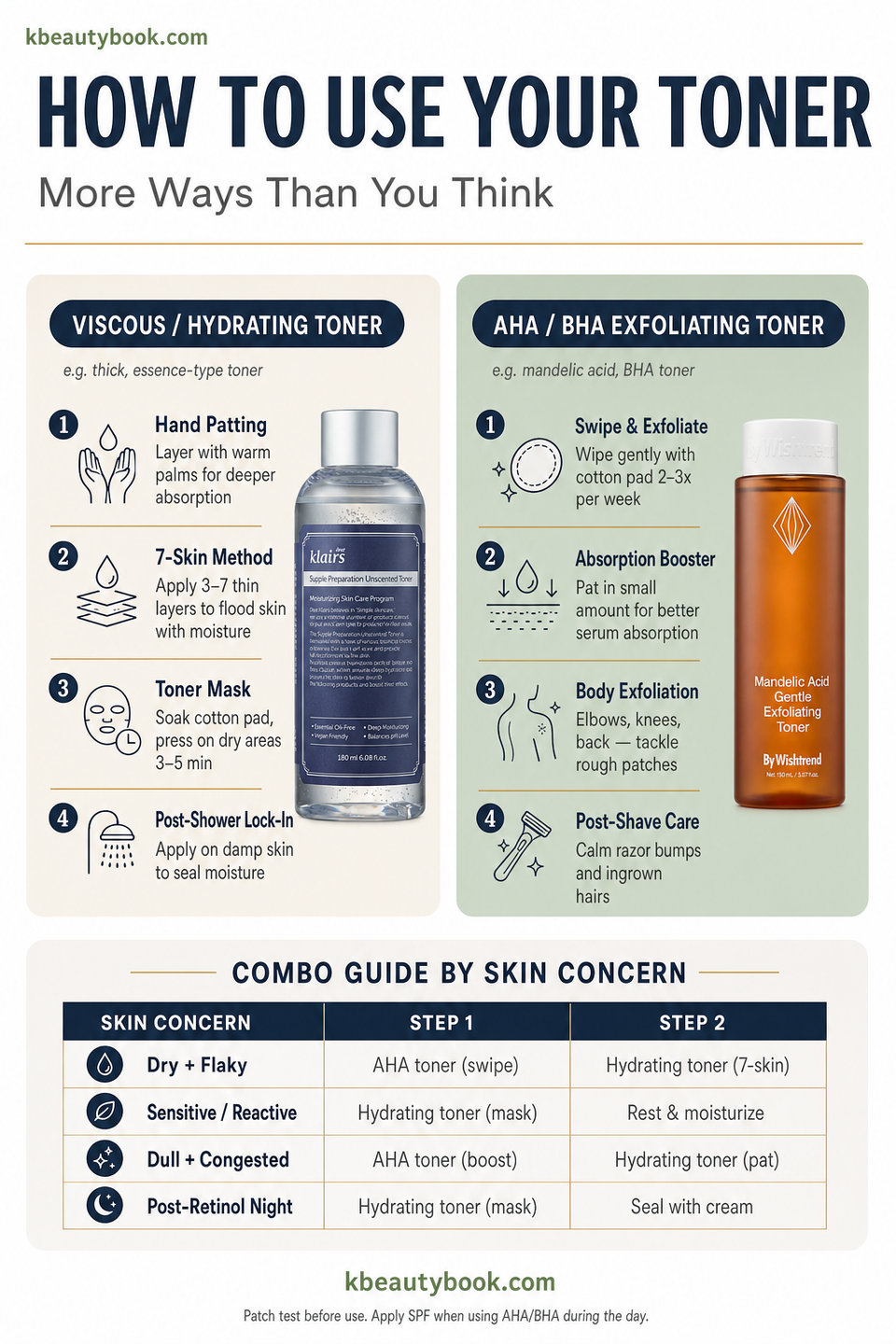
Method 1 — Hand Patting: The Korean Skincare Foundation
Pour toner into your palms and press gently across the face, using your hands' warmth to encourage absorption. No cotton pad waste, no product loss. The slight viscosity of K-beauty essence-toners means each pat "grips" the skin rather than sliding off. This is the baseline of Korean skincare application technique.
Method 2 — 7-Skin Method & Skin Flooding: The K-Beauty Hydration Stack
The 7-skin method is a Korean skincare practice designed to maximize hydration by layering toner or essence onto the skin up to seven times. Each layer builds upon the last, allowing the skin to absorb lightweight hydration gradually, leaving it soft, supple, and ready to absorb subsequent skincare products more effectively.
Key rule: This only works with alcohol-free, fragrance-free, non-exfoliating hydrating toners. The Supple Preparation Unscented Toner is one of the most widely used toners for this technique globally — the K-beauty glass skin formula in its purest form.
Skin flooding takes this further: apply multiple layers while skin is still damp to lock in moisture at the cellular level — the Korean beauty approach to plump, dewy skin without heavy creams.
Best for: dry weather, post-flight skin, air-conditioned environments, or any day your skin feels tight and dehydrated.
Method 3 — Toner Mask: Instant Calming in 5 Minutes
Soak a cotton pad generously with toner and press onto dry or irritated areas for 3–5 minutes. This is the Korean skincare equivalent of a sheet mask — using a product you already own. Most useful the morning after retinol, strong vitamin C, or any active that left skin sensitized.
"I have extremely sensitive skin and struggled with fungal acne after the pandemic. This toner has been repurchased 10+ times without ever causing a breakout." — Verified iHerb review, K. L.***
Method 4 — Post-Shower Lock-In: Moisture Before It Evaporates
Apply toner immediately after showering, while skin is still slightly damp. Wet skin is more permeable — humectant ingredients like hyaluronic acid and beta-glucan bind to the water already present, creating deeper hydration than dry-skin application. A well-established Korean skincare habit for maximizing toner efficacy with zero extra products.
Part 7. AHA/BHA Toner: 4 Ways to Use It
Product referenced: Mandelic Acid 5% Gentle Exfoliating Toner — By Wishtrend
Method 1 — Swipe Exfoliation (닦토, Dak-to): The Classic K-Beauty Exfoliation Step
Saturate a cotton pad and sweep gently across the face following skin texture. In Korean skincare, this technique is called "닦토 (Dak-to)" — literally "wipe toner." It's the entry point for chemical exfoliation in K-beauty routines, and mandelic acid's large molecular size makes it the gentlest starting point. Use 2–3 times per week.
Method 2 — Absorption Booster: Prep Your Skin for Everything That Follows
After wiping, pat a small amount of remaining toner into skin with fingertips. The exfoliated surface absorbs serums, essences, and moisturizers significantly more efficiently. This is why Korean skincare routines often sequence an AHA toner before active serums — exfoliation isn't just about removing dead cells, it's about maximizing everything that comes next.
"I bought it for exfoliation but what I noticed most was how much better my serum absorbs afterward. My skin texture has improved noticeably." — Naver review
Method 3 — Body Care: The Use Most People Miss
Many Korean skincare users have discovered that AHA toners work beyond the face. The By Wishtrend Mandelic Acid toner is particularly well-suited for full-body use.
Elbows, Knees, Back — Thick, Neglected Skin: Rough, discolored elbows and knees are caused by the same dead cell buildup that dulls facial skin. Saturate a cotton pad and sweep the area gently. The mandelic acid gradually softens and brightens these zones over consistent use. Always follow with a rich body moisturizer.
Razor Bumps & Ingrown Hairs: Post-shave irritation responds well to mandelic acid. The antibacterial properties target bacteria that colonize irritated follicles, while panthenol and centella asiatica in the formula calm inflammation simultaneously. Apply with a cotton pad to freshly shaved areas, or pat directly with fingertips. This use has made the toner a growing favorite in men's skincare routines globally.
Bacne, Décolletage & Shoulder Congestion: Summer breakouts on the back and shoulders respond well to AHA toner application 2–3 times a week. Body skin is generally more tolerant of acid application than facial skin, but always patch test first.
⚠️ Body use note: If applying during the day, use SPF 30+ on all exposed areas. AHAs increase photosensitivity.
Method 4 — Frequency Calibration: Building Your Personal K-Beauty Routine
The K-beauty principle here is patience: consistent low-frequency use outperforms aggressive high-frequency application. Start with 2–3x per week for sensitive skin. Intermediate users can try 8–10% glycolic. Build slowly, monitor skin response, and adjust.
Part 8. Combo Guide by Skin Concern
| Skin Concern / Situation | Step 1 | Step 2 |
|---|---|---|
| Rough texture + dehydration | AHA toner swipe (닦토) | Hydrating toner hand patting |
| Extreme dryness / seasonal change | Hydrating toner skin flooding (3–5 layers) | — |
| Night after retinol | Hydrating toner mask (5 min) | Barrier moisturizer |
| Before makeup | Hydrating toner hand patting | — |
| Maximize serum absorption | AHA toner → serum | Hydrating toner finish |
| 2–3x/week K-beauty exfoliation routine | AHA toner swipe | Hydrating toner 7-skin method |
| Post-shave / body exfoliation | AHA toner swipe | Rich body moisturizer |
⚠️ Caution: Do not combine AHA/BHA toner with other strong acid products on the same evening. Avoid physical scrubs on the same day.
Part 9. Q&A — Everything You've Searched For
Q1. What makes K-beauty toners different from Western toners?
Korean beauty toners are formulated as the first hydration step — not a cleansing wipe. K-beauty toners are typically alcohol-free, essence-textured, and designed for layering (7-skin method, skin flooding). The goal is building the "glass skin" effect through strategic, repeated hydration. Western toners historically focused on pH restoration and residue removal.
Q2. What is the 7-skin method and is it a real Korean skincare technique?
Yes. The seven skin method is a Korean skincare technique where you apply the same hydrating toner to your face in multiple thin layers, typically up to seven times. "Skin" (스킨) is the Korean word for toner — hence the name. It became a global K-beauty trend and is now practiced worldwide for deep hydration without heavy creams.
Q3. Can I use a hydrating toner with the 7-skin method every day?
Yes — if the toner is alcohol-free, fragrance-free, and contains no exfoliating acids. If your skin barrier is compromised, start with 2–3 layers and build up.
Q4. Is mandelic acid safe for sensitive skin?
Yes. Mandelic acid has the largest molecular weight among AHAs (152 Da), penetrating skin more slowly and causing less irritation than glycolic acid. It is the gentlest AHA — the K-beauty recommended starting point for chemical exfoliation. Start at 2–3x per week and always patch test first.
Q5. Glycolic acid vs. mandelic acid — which should I choose?
Glycolic acid (76 Da) penetrates fastest and delivers the strongest results — but also the highest irritation risk. Sensitive skin should start with lactic or mandelic acid at 5% and build slowly. If you're new to chemical exfoliation or have reactive skin, mandelic acid is the K-beauty-recommended starting point.
Q6. Can I use AHA toner and hydrating toner on the same day?
Yes. Sequence matters: AHA toner first to exfoliate → then hydrating toner to replenish moisture. On sensitive days, skip the AHA and use only the hydrating toner.
Q7. Does AHA toner require SPF?
Non-negotiable. AHA thins the stratum corneum, increasing UV sensitivity. SPF 30+ daily is the minimum; SPF 50 is recommended when using AHA toners regularly.
Q8. Can I use azelaic acid and AHA toner together?
Alternate rather than combine. Use AHA toner on exfoliation nights (Mon/Wed/Fri), azelaic acid on off nights (Tue/Thu/Sat). AHA clears the surface; azelaic acid addresses inflammation and pigmentation underneath — complementary, not competing.
Q9. Can I use retinol and AHA toner on the same night?
Not recommended. Alternate evenings: AHA toner nights and retinol nights. On retinol nights, use your hydrating toner to support barrier recovery.
Q10. Niacinamide and AHA toner — compatible?
Yes, in sequence. AHA toner first → niacinamide serum after absorption. This combination addresses texture (AHA) and pigmentation/pore minimizing (niacinamide) in one K-beauty routine.
Q11. Can AHA toner be used on the body?
Yes. Elbows, knees, back, décolletage, and post-shave areas all respond well to AHA toner. Mandelic acid is particularly well-suited for body use given its low irritation profile. Patch test first, and always apply SPF to exposed areas during the day.
Q12. Is AHA toner safe during pregnancy?
Glycolic and salicylic acids are generally advised against during pregnancy. Mandelic acid is considered relatively safer, but any active ingredient during pregnancy should be discussed with your OB-GYN. The safest option: the fragrance-free, alcohol-free Supple Preparation Unscented Toner.
Q13. What if my skin barrier is damaged — can I still use AHA toner?
Pause AHA use when the skin barrier is compromised (stinging, redness, sensitivity, flaking). Use only your hydrating toner in toner-mask format to calm and rebuild the barrier. Restart AHA at 1–2x per week once skin has stabilized.
Q14. What is the Korean beauty philosophy behind using toner?
In Korean skincare, toner is called "스킨 (skin)" — it IS the skin foundation. The K-beauty philosophy is "layer, don't wipe": build hydration in thin, repeated layers to create a saturated, resilient moisture barrier. This is why Korean beauty achieves "glass skin" not with heavy creams, but with strategic toner layering.
Part 10. Where to Shop
Dear Klairs
- 🌿 Olive Young Global — Klairs Store
- 💛 YesStyle — Klairs Store
- 🎀 StyleKorean — Klairs Store
- 📦 Amazon — Klairs Store
By Wishtrend
- 💛 YesStyle — By Wishtrend Store
- 📦 Amazon — By Wishtrend Store
Browse all products: www.klairscosmetics.com | bywishtrend.com