"Everyone's Journaling These Days" — The Korean Mindfulness Practice That's Quietly Changing How People Manage Anxiety
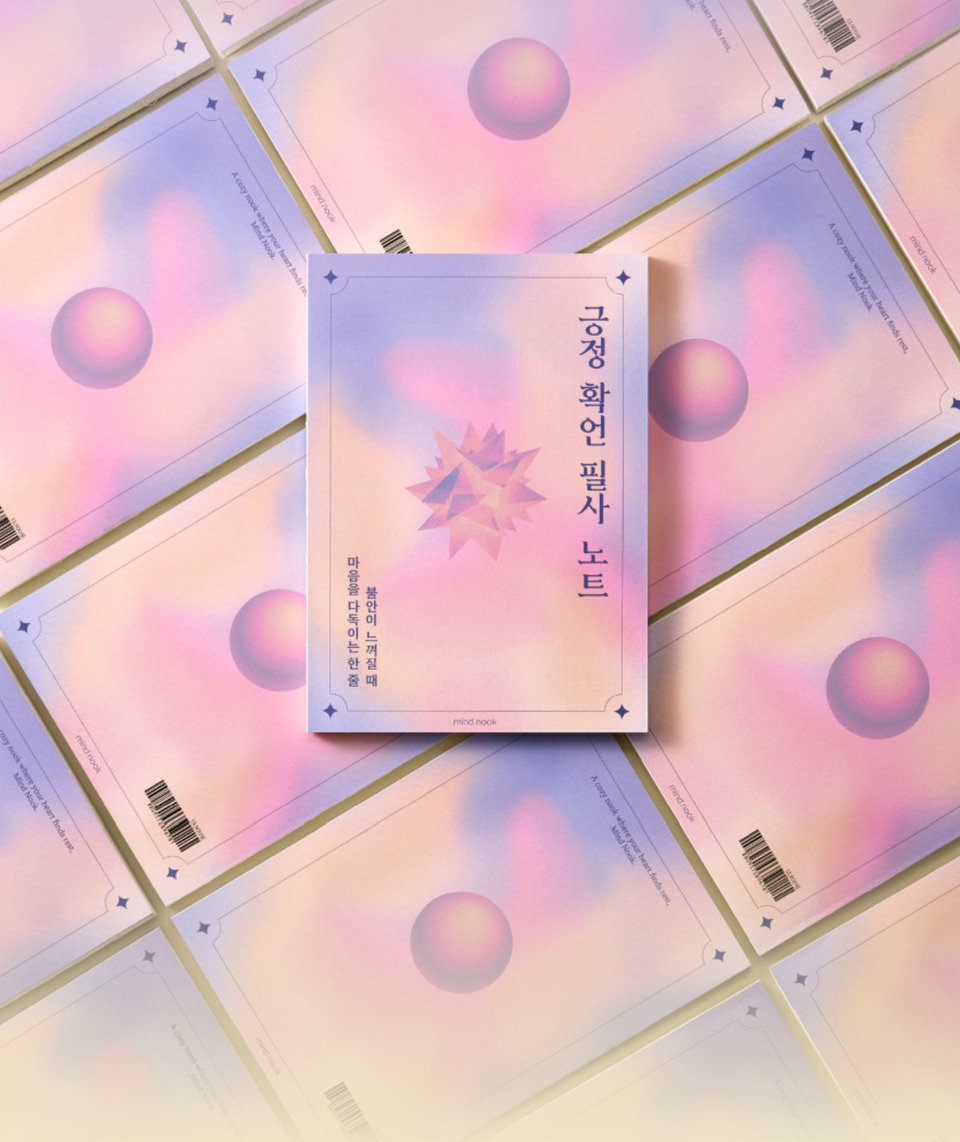
Listen to this post as a podcast — Mind Nook Positive Affirmation Journal
Last updated: June 14, 2026 | Version 1.0
⚡ TL;DR — Quick Answer
Mind Nook's Positive Affirmation Journal (긍정확언 필사노트) is a Korean mindfulness journaling notebook designed to help adults manage anxiety through pilsa — the intentional act of copying positive affirmations by hand. Built on cognitive psychology's Depth of Processing theory, it contains 66 affirmation sentences across 5 anxiety types, a 180-degree lay-flat sewn binding, and QR-linked original music composed by Mind Nook. No dates, no pressure — just one sentence, whenever you need it.
📋 Table of Contents
- The Quiet Ritual Taking Over Korean Social Media
- What Is Pilsa? Korea's Mindfulness Answer to the Scroll
- Why Handwriting Works — The Psychology Behind Pilsa
- What Is Mind Nook? A K-Wellness Brand Born From the Need to Rest
- 5 Features That Set This Journal Apart
- Real Voices — What People Are Saying
- Who Is This For?
- The Bigger Picture — K-Wellness Goes Global
- Where to Buy
- FAQ
The Quiet Ritual Taking Over Korean Social Media
Scroll through Korean social media right now and you'll notice something. Flat lays of open notebooks. A single sentence, written in careful, deliberate handwriting. A short caption: "This line saved me today."
It's not journaling in the Western sense — no bullet points, no daily logs, no productivity tracking. It's something quieter. Something older. It's called pilsa (필사) — the Korean practice of copying meaningful words by hand — and in 2026, it has become one of the most talked-about forms of self-care in Korea.
In a culture navigating burnout, uncertainty, and the constant pressure to optimize, people are searching for something simpler: a way to slow down, feel their feelings, and come back to themselves. Pilsa is that answer — analog, intentional, and deeply personal.
What Is Pilsa? Korea's Mindfulness Answer to the Scroll
Unlike meditation, which requires stillness and practice, or therapy, which requires scheduling and cost, pilsa asks only for a pen, a notebook, and ten minutes. You find a sentence that resonates. You read it aloud. Then you write it — slowly, deliberately, one character at a time.
Rather than ignoring or suppressing stress, this practice focuses on recognising emotional signals early and responding with structured regulation — a form of mindfulness that doesn't require an app, a studio, or a subscription.
Mental health is not seen as a condition that one either has or does not have, but as a skill that can be trained. Pilsa embodies this philosophy perfectly: every time you write a positive affirmation by hand, you are training your mind to believe it.
Why Handwriting Works — The Psychology Behind Pilsa
Reading a sentence and writing it are completely different experiences in the brain.
Cognitive psychology explains this through the Depth of Processing theory: information processed through active, physical engagement — like handwriting — is encoded far more deeply in memory than passive reading. When you copy a positive affirmation by hand, that sentence doesn't just pass through your eyes. It moves through your fingers, your arm, your body. It becomes embodied.
There's something else handwriting does that screens cannot: it slows you down. In a world of infinite scroll and instant gratification, the act of stopping — of choosing one sentence and writing it slowly — is itself a mindfulness practice. That pause is the healing.
"I'd flip through the pages and when a sentence hit me, I'd stop. Read it out loud. Then write it slowly, one character at a time. By the time I finished a few lines, the anxiety had quieted down a little. That's all I needed."
— Thread review, Mind Nook user
What Is Mind Nook? A K-Wellness Brand Born From the Need to Rest
Mind Nook (마인드눅) takes its name from two words: Mind and Nook — meaning "a cozy corner where anyone can come and rest whenever they need to."
Founded in 2021 as a meditation and wellness content creator, Mind Nook earned YouTube and TikTok Silver Play Buttons while building a global community around accessible mental wellness. As Korea's wellness industry shifts from surface-level aesthetics toward deeper emotional care, Mind Nook has been leading that conversation.
The Positive Affirmation Journal is the brand's philosophy made physical: a tool for anyone who wants to take care of their mind but doesn't know where to start. This isn't just a pretty notebook. It's a structured mental wellness tool, built on anxiety research and cognitive psychology, designed for the real texture of modern life — busy, irregular, and often exhausting.
5 Features That Set This Journal Apart
1. 🧠 Anxiety Mapped Across 5 Root Causes
Most affirmation journals give you generic positivity. Mind Nook goes deeper. The journal identifies 5 categories of anxiety and gives you affirmations specifically designed for each:
| Anxiety Type | What It Addresses |
|---|---|
| 🙋 Self | Low self-esteem, self-criticism, inner pressure |
| 🤝 Relationships | Anxiety from others — conflict, loneliness, comparison |
| 🔮 Future | Uncertainty, fear of failure, "what ifs" |
| 📖 Past Experiences | Regret, rumination, unresolved emotions |
| 🌍 Environment | External stressors — work, society, circumstances beyond your control |
2. ✍️ 66 Affirmations — The Science of Habit Formation
The journal contains exactly 66 affirmation sentences — one for each day of a 66-day practice. This is grounded in psychological research showing that 66 days is the average time needed for a new behavior to become automatic. By the time you reach the last page, the habit of turning to words — rather than spiraling — will have already taken root.
3. 📖 Lay-Flat Sewn Binding — Because Comfort Matters
The journal uses a 180-degree lay-flat sewn binding (사철 제본), meaning every page opens completely flat without resistance. No hand cramps from holding the book open. No pages springing back. Just your pen, the paper, and the sentence in front of you.
4. 🎵 QR-Linked Original Music — A Multi-Sensory Ritual
Inside the journal, a QR code connects to a playlist of original music composed by Mind Nook — calming tracks designed to accompany your writing practice. One reviewer described the experience:
"I put on the music from the QR code and started writing — it felt like the most peaceful time I'd had in months. I felt like I'd discovered treasure."
— shin******* (Verified purchase)
5. 📅 No Dates — No Pressure
The journal contains no date fields. You don't need to write every day. You don't need to keep a streak. You pick it up when you need it — on a hard morning, in a quiet evening, when something breaks and you need something to hold onto.
💡 New to journaling? The absence of dates means zero guilt when you skip a day. Just come back when you're ready — at your own pace, on your own terms.
Real Voices — What People Are Saying
💬 "This has become my healing routine."
"The sentences are so comforting — it felt like finding treasure. I put on the music from the QR code and wrote for a while, and it was the most peaceful time I'd had in ages. The sewn binding means it opens completely flat, which makes writing so much easier."
— shin******* (Verified purchase)
💬 "I didn't write every day. That's exactly why I kept going."
"There are no dates, so I don't feel pressure to write daily. I just pick it up when I need it — sometimes every day, sometimes once a week. That flexibility is what made me stick with it."
💬 "I bought it for a friend. Then bought one for myself."
"My friend loved it so much. The words are so beautiful — I ended up ordering my own. It's the kind of gift that actually means something."
— ilov***** (Verified purchase, repeat buyer)
💬 "Writing it down made me actually believe it."
"Reading affirmations on a screen never really worked for me. But writing them by hand felt different — like I was telling myself something, not just reading it. The words stuck."
Who Is This For?
- ✅ Anyone navigating anxiety, burnout, or emotional fatigue
- ✅ People curious about mindfulness but find meditation difficult
- ✅ Beginners to journaling — no prompts, no structure required beyond the affirmations
- ✅ Fans of K-wellness and Korean self-care culture
- ✅ People looking for a screen-free daily ritual
- ✅ Gift-givers — birthdays, self-care gifts, "thinking of you" gestures
- ✅ Korean language learners — all affirmations are in Korean, making this a beautiful cultural and language immersion tool
The Bigger Picture — K-Wellness Goes Global
In 2026, the next phase of wellness moves beyond performance, towards emotional repair, nervous-system safety and embodied care. Korea got there first.
While the global wellness industry was still focused on optimization — tracking, biohacking, performance — Korean culture was quietly building something different: a wellness philosophy centered on rest, emotional honesty, and daily ritual. Mind Nook's Positive Affirmation Journal is a piece of that culture, packaged and made accessible. It's K-wellness in its most honest form: no performance, no pressure, just a quiet corner for your mind.
Where to Buy
📍 Official Online Store
👉 Mind Nook Positive Affirmation Journal — Naver Smartstore
FAQ
Q. What language are the affirmations written in?
A. All 66 affirmations are written in Korean (한국어). Korean language learners often find it a beautiful and emotionally resonant way to practice reading and writing.
Q. Do I need to write every day?
A. Not at all. The journal has no date fields — you use it whenever you feel called to. Many users find this flexibility is exactly what allows them to keep the habit long-term.
Q. How is this different from a regular diary or journal?
A. A regular diary is for recording events. This journal is for absorbing — you're not writing about your day, you're copying a sentence crafted for your emotional state. The affirmations are pre-crafted based on anxiety research, so you don't have to figure out what to write. You just copy, breathe, and feel.
Q. Is this suitable as a gift?
A. Many buyers purchase it as a gift first — and then order one for themselves. It's a particularly thoughtful gift for anyone going through a stressful period, a life transition, or simply someone who deserves a moment of care.
Q. What is pilsa exactly?
A. Pilsa (필사) is the Korean practice of copying text by hand. Traditionally used for literary or spiritual texts, it has evolved into a modern mindfulness practice — particularly popular among adults seeking calm in a high-pressure culture. Think of it as handwriting meditation.
One Sentence. Ten Minutes. A Little More Peace. 💛
"I am allowed to take up space."
"It's okay to go slowly."
"I am doing enough."
Write it down. Read it again. Let it land. That's pilsa. And it's waiting for you on the first page.