Skip-Care: The Korean Skincare Trend Redefining Beauty in 2026
Last updated: July 9, 2026 | Version 1.0
Listen as Podcast — Skip-Care 2026 Trend Guide
TL;DR
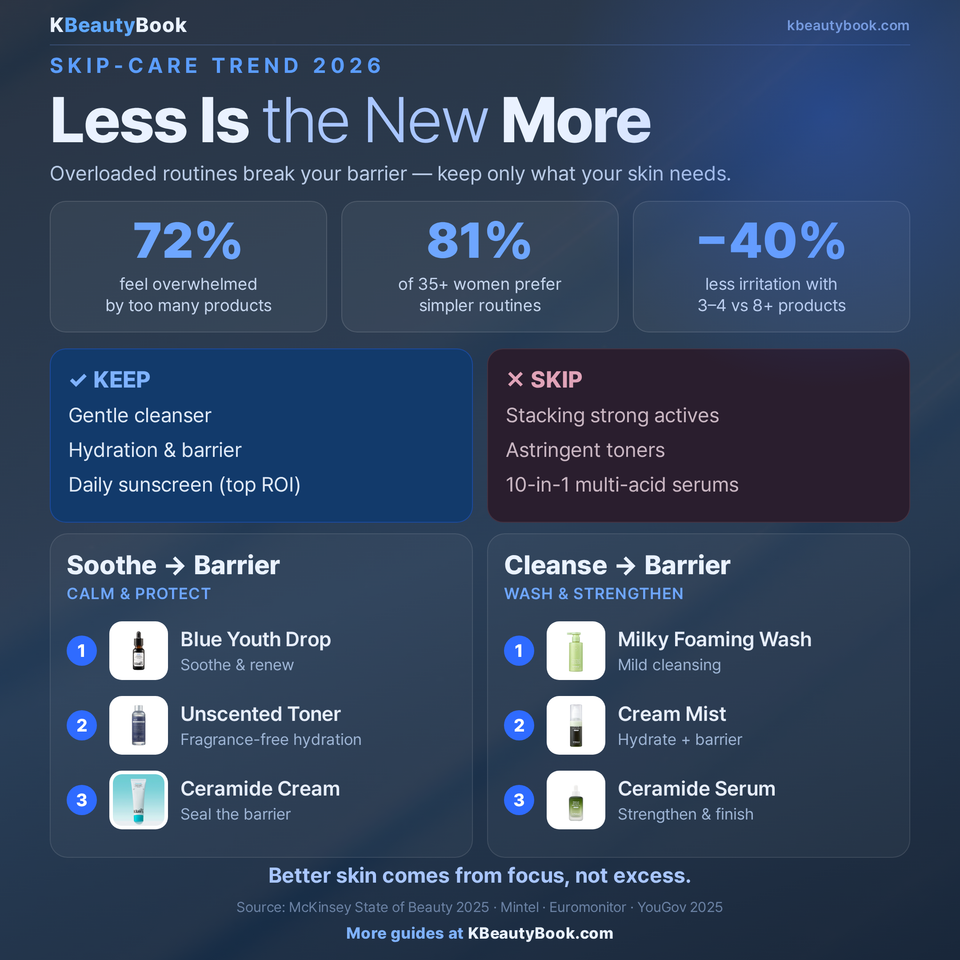
Skip-care isn't about lazily cutting steps — it's intelligent minimalism (skinimalism): repairing the skin barrier that ingredient overload broke, and keeping only what your skin truly needs. With 72% of consumers overwhelmed by too many products, skip-care has moved beyond a fad to become the new standard of skin health. At its core: protect the cleanser · moisturizer · sunscreen trio, and focus on barrier-repair ingredients (ceramide, panthenol, niacinamide) — a philosophy modern Korean skincare (K-beauty) is now leading.
Key Takeaways
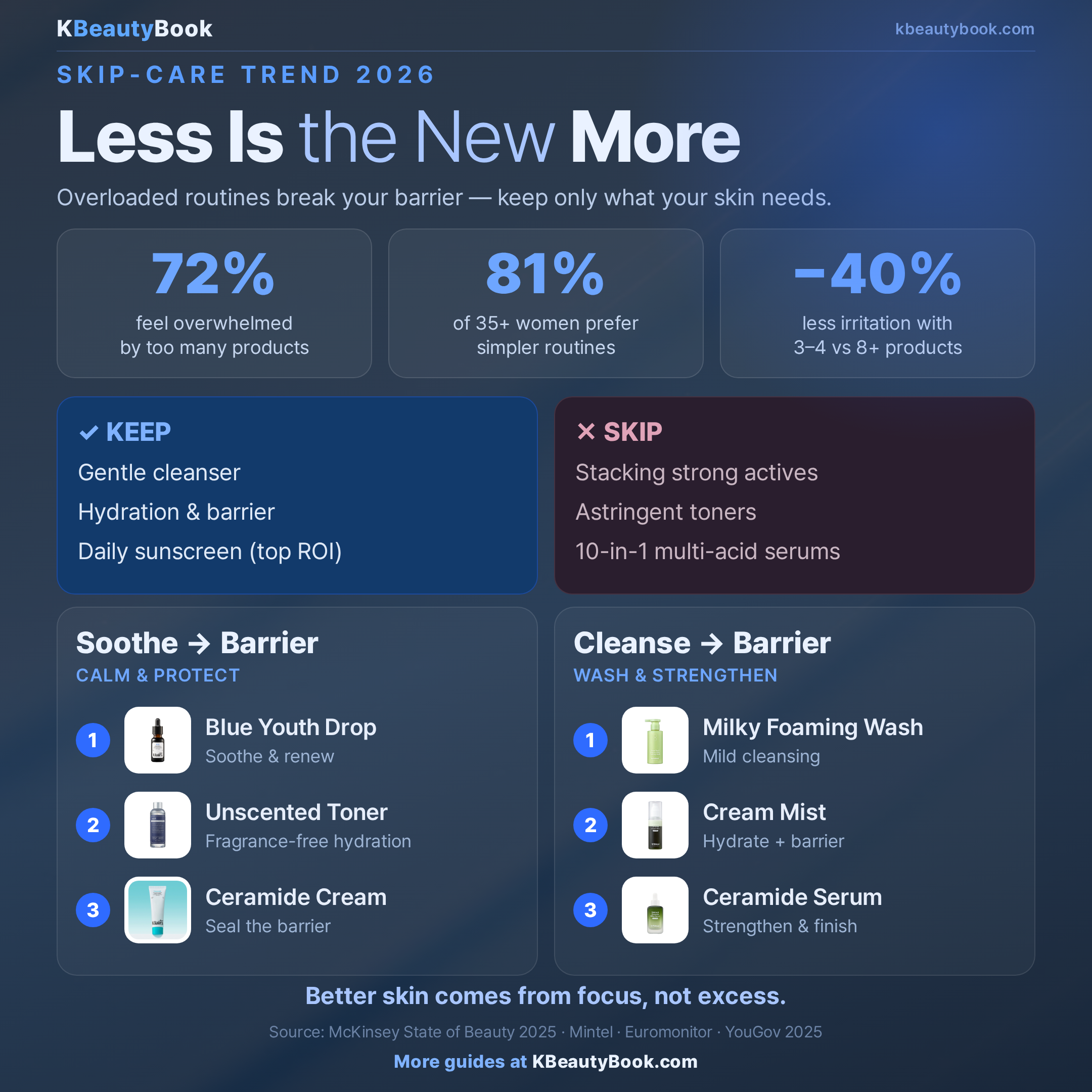
- 72% of consumers feel overwhelmed by new product launches, and 81% of women aged 35+ prefer a simpler routine. (McKinsey State of Beauty 2025)
- 64% of skincare users want fewer, more effective products; 63% prioritize multifunctional products. (NPD Group)
- The skinimalism market is growing at 9.8% CAGR (2025–2034) — roughly 3× faster than the overall skincare market (~3.1%).
- TikTok #skinbarrier has passed 300M views; "moisturizer for dry skin" searches grew +129%, "sensitive skin care" +34%.
- Clinical-trial publications for barrier-repair actives rose 67% from 2020 to 2025, backing the trend with science.
- Asia-Pacific holds 40.2% of the global skincare market, placing K-beauty at the center of the skip-care shift.
Table of Contents
- Skip-Care: Why Now?
- What Defines the Skip-Care Trend: Simple ≠ Lazy
- Skip-Care Must-Dos: How to Use Less and Use Better
- Two Skip-Care Routines, Named by Function
- How to See Skip-Care
1. Skip-Care: Why Now?
A post that went viral in a skincare community summed it up: after dropping all high-strength actives for about two months and simplifying the routine, the skin actually got better. Similar confessions followed — "my skin only changed after I removed unnecessary products," "I went back to basics after years of multi-step routines and got my best skin ever."
This isn't just social-media sentiment — the data points the same way. McKinsey's State of Beauty 2025 found 72% of consumers are overwhelmed by the pace of launches, with younger shoppers reporting the most fatigue. Today's consumers are "value-sensitive, skeptical of hype, and focused on whether a product actually works." In the UK, 39% of adults already follow a minimalist 1–3 step routine, versus just 3% using many steps (YouGov, Sept 2025).
Great products already flood the market. The real question became: how do you take away? — a question that modern Korean skincare is answering better than anyone.
2. What Defines the Skip-Care Trend: Simple ≠ Lazy
① A collective rethink of ingredient overload
Layering acids, vitamin C, niacinamide and retinoids all at once left many with chronic irritation and redness. Using 3–4 products is associated with approximately 40% less skin irritation than using 8 or more. Now consumers ask "what can I remove?" before "what can I add?" — reflected in the 64% who want fewer but effective products (NPD).
② A return to barrier-first, 2–3 step routines
Instead of stacking layers, the trend centers on ceramide, panthenol, and niacinamide to restore and calm the barrier. Ceramides make up ~50% of the skin's composition, and #skinbarrier has topped 300M views on TikTok. "Moisturizer for dry skin" searches grew +129%, "sensitive skin care" +34%.
③ The rise of multitasking products
Rather than six serums, one hybrid formula that hydrates, brightens and reinforces the barrier. 63% of consumers prioritize multifunctional products, and demand for skincare-makeup hybrids (e.g., moisturizer + SPF) is set to grow +30%. Post-pandemic, 29% of female consumers switched to multifunctional products as they reduced skincare time (Mintel).
④ How K-Beauty absorbed skip-care
Once famous for the "10-step routine," K-beauty now leads with brands that say what to remove first, evolving toward "high-function minimal." With Asia-Pacific commanding 40.2% of the global market, Korean skincare sits at the heart of this shift. The skinimalism market is growing at 9.8% CAGR (2025–2034), 3× faster than the overall market.
3. Skip-Care Must-Dos: How to Use Less and Use Better
Skip-care isn't about skipping because you're lazy. It's about removing what needs to go, and focusing more deeply on what remains — that's the essence of skip-care.
① Read your barrier signals first
Frequent tightness, redness or sensitivity means your routine is weakening the barrier. Too many strong actives at once break down the barrier, leading to redness, stinging, breakouts, and increased sensitivity. Ironically, many people add more products in this situation, deepening the cycle. Pause high-strength actives (retinoids, AHA/BHA) and give skin time to recover first.
② Never skip these three
Skip-care isn't skipping everything. Cleanser, moisturizer, sunscreen — these three are non-negotiable. Moisturizer is used by 70% of consumers and is the most fundamental product. Sunscreen (59% usage) has the highest ROI in all of skincare — preventing photoaging, pigmentation and skin cancer. Keep these three at the center and remove everything else.
③ Identify skippable steps
Toner, essence, eye cream, face mist are skippable for most skin types. If you can't confidently say a step changes your skin, cut it. Especially: skip astringent toners — "pore-minimizing," "deep-cleansing," "astringent" essentially means "stripping." If you use a toner, make it hydrating. Also avoid serums with 5+ actives ("10-in-1 serums") — they sound impressive but often cause reactions in sensitive skin.
④ Replace steps with one multitasker
Prefer one proven, multi-benefit formula over trendy add-ons. One serum that hydrates and reinforces the barrier simultaneously, one cream that soothes and moisturizes together, can replace three or four steps. 40% of consumers choose simplicity over complexity.
⑤ Consistency beats length
Skin needs consistency, not complexity. That's the foundation of healthy, balanced skin. 3 steps done daily beat 20 steps done erratically. 75% agree a consistent routine boosts overall wellbeing and confidence.
⑥ Differentiate AM and PM
Morning and evening have different skin needs. Mornings: finish with moisturizer + sunscreen. Evenings: focus on barrier repair. Actives only in the evening, one at a time. Even the dermatologist-recommended sensitive-skin routine is structurally simple: "AM = gentle cleanser + ceramide + SPF / PM = barrier cream."
4. Two Skip-Care Routines, Named by Function
Organize by purpose, not brand, and it looks like this:
🔵 Soothe → Barrier Skip-Care
For skin prone to redness and sensitivity. Calm irritated skin first, then lock it in with the barrier — a 3-step approach.
| Step | Product | Role |
|---|---|---|
| Step 1 | Blue Youth Activating Drop | Guaiazulene instant calming + skin renewal support |
| Step 2 | Unscented Toner | Fragrance-free, alcohol-free hydration + pH balance |
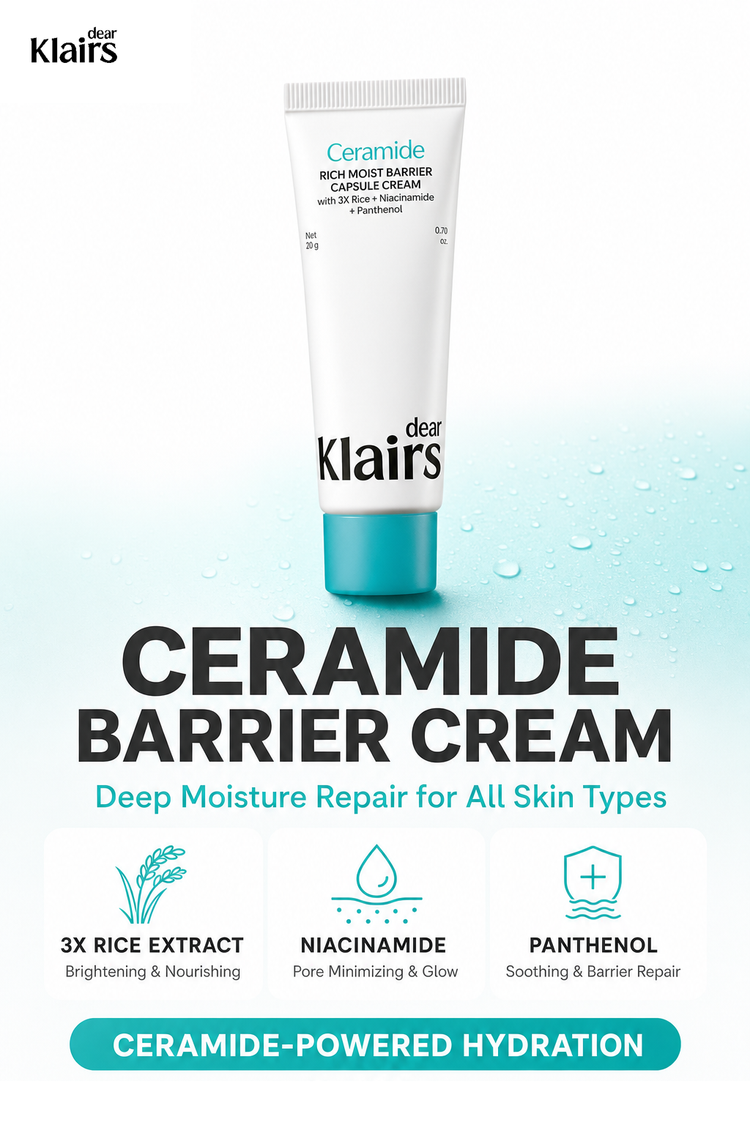
| Step 3 | Ceramide Barrier Cream | Barrier reinforcement + moisture seal |
🟦 Cleanse → Barrier Skip-Care
For skin with an unstable moisture-oil balance. Wash, then immediately strengthen — a minimal set.
| Step | Product | Role |
|---|---|---|
| Step 1 | Milky Foaming Wash | Gentle low-irritation cleanse without barrier damage |
| Step 2 | Matcha & Ceramide Cream Mist | Hydration + barrier care in one step, replaces toner |
| Step 3 | Ceramide Serum or Cream | Barrier reinforcement finish, choose by skin condition |
Both routines follow skip-care's core principle: "remove, but focus on what remains." With the hydration & barrier-repair segment leading the skinimalism market, these two routines sit right at the trend's center.
5. How to See Skip-Care
Skip-care is the conclusion consumers reached, exhausted by information overload and product overload. Famous ingredients didn't fix things; expensive stacks didn't work. The destination was "taking away." Today's shopper looks past a crowded INCI list for "the one thing my skin truly needs" — supported by the 54% who actively seek clean, transparent ingredient lists.
Importantly, skip-care isn't about spending less — it's about investing more in the core categories. Sales of core products (multi-cleansers, day moisturizers, treatments) are rising while rarely-used extras decline.
Better skin comes not from applying more, but from focusing on what your skin truly needs.
FAQ
Q. What exactly is skip-care?
A. Skip-care is a skincare approach that deliberately "skips" steps your skin doesn't need to simplify the routine. You keep essentials — cleansing, moisturizing, sun protection — while removing excess actives and redundant products to keep the skin barrier healthy.
Q. Is skip-care the same as skinimalism?
A. Related but distinct. Skinimalism is the broader "less is more" aesthetic; skip-care focuses specifically on consciously skipping unnecessary steps. Today they converge into "smart minimalism."
Q. Won't skip-care make my skin drier?
A. Usually the opposite. Too many products can disrupt the skin's natural barrier; switching to a simple, barrier-first routine often restores its ability to hold moisture. Cleanser → barrier serum/cream → sunscreen is enough.
Q. Which ingredients are essential in Korean skincare skip-care?
A. Ceramide, panthenol, niacinamide and hyaluronic acid. Ceramide is key — it makes up about 50% of the skin's composition and is central to barrier repair.
Q. How many steps should a skip-care routine have?
A. For most skin types, 2–3 steps morning and night is enough. In fact, 39% of UK consumers already follow a 1–3 step routine.